Private
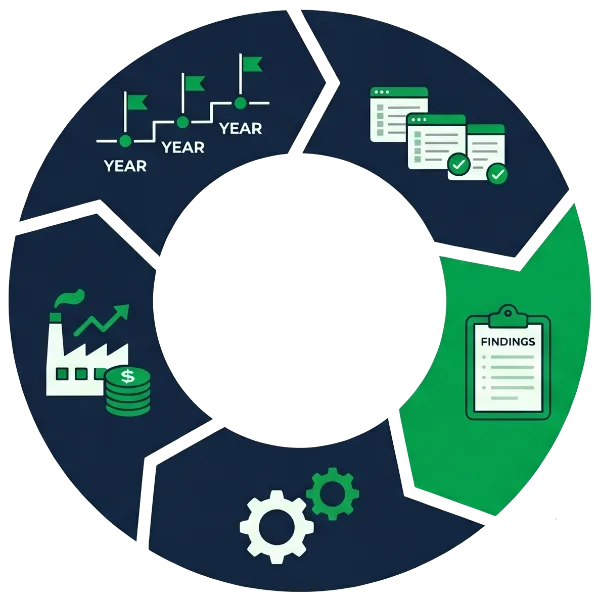
The findings go only to you. Nobody else sees them unless you choose to share them.

Free readiness review
When you commission us to verify your footprint, we start with a free, private readiness review of the information you already have. We work alongside the people who built the footprint, point out anything that needs strengthening, and give your team time to put it right before formal verification begins. What we find at this stage stays with your team. We do not increase your verification fee to cover the review.
Free when you commission verification
We agree your reporting period, boundaries, the emissions to be covered, the assurance level and your deadline, then confirm the fee.
We review the information you already have, from part-year or last year’s data, months before your deadline. Your team gets private, documented feedback to act on at its own pace.
We verify the complete reporting period, an independent reviewer checks our work, and you receive your verification statement and findings report.
Built with you, not against you
Commissioning verification can feel like inviting someone to mark your homework. If the footprint has problems, it is the person who built it who feels exposed, and that puts many organisations off getting the assurance they need. We designed the readiness review to work the other way round.
Carbon accounting changes every year. Emission factors are updated, the GHG Protocol is being revised, and Scope 2 and Scope 3 guidance keeps moving. A footprint that was right when it was built can need updating a year later. A finding is rarely a judgement on the person who prepared the figures; more often, the rulebook has changed. We look at footprints every day, so we spot these patterns quickly.
The findings go only to you. Nobody else sees them unless you choose to share them.
We explain what needs strengthening and the requirement behind it. Your team makes the corrections, so the improved footprint is your work.
Points you resolve at this stage do not appear in your verification statement or findings report. Formal verification covers the final figures you submit.
We find it. You fix it. The board sees the verified result.
If it helps, we will also give you a short note for your board or finance director explaining why independent verification has been commissioned and what it covers.
Start early
When verification is left until the deadline is close, the pressure lands on your team. Evidence is pulled together in a hurry, gaps turn up late, and each one becomes another request and another round of emails, just when you have the least time to answer them.
That is also when simple slips happen: a COUNT where a SUM should be, or an estimate that goes in with no note of how it was worked out. The errors we find most often.
Start early and it works the other way round. The readiness review gives you our feedback months ahead, privately, to act on at your own pace. By the time the deadline arrives, the hard part is done. Left unchecked, the late scramble becomes footprint fatigue.
Our feedback arrives months before the deadline, so your team can fit the fixes around everything else it has to do.
Gaps in the evidence are found early, when they are easy to fill, not in the final week when every missing record means another chase.
SECR figures ready when the accounts are signed, CDP submitted on time, customer questionnaires answered. Nobody needs to know it was ever close.
Because a team that starts early has a smoother verification, and a client whose first year goes well stays with us. We treat the review as an investment in a long relationship, so we do not recover its cost through your fee.
There is no first-year surcharge, and the free review does not inflate this year’s fee. Once you are with us there is no lock-in: you commit one year at a time, and if your scope stays the same your renewal fee rises by no more than CPI inflation. Why price should never be the reason you leave.
Start with available information
We can test the data, methods and controls already available during the current reporting year.
We can examine the prior inventory and methodology, considering changes affecting the current reporting period.
We identify concerns, explain the relevant requirements and specify the evidence needed to assess their resolution.
What we examine
Entities, sites, emissions sources, categories and exclusions within the agreed reporting boundary.
Emission factors, assumptions, conversions, consolidation and calculation methods.
Source records, the audit trail and how people collect, check and approve information.
An example timetable
For a 31 December year-end, an early review gives your team time to act. We agree the window around your information and our capacity.
Your team finalises the annual figures and supporting evidence, incorporating relevant corrections.
Once the complete inventory is available, we verify the reporting period and assess the resolution of earlier findings.
We agree the actual dates around your year-end, your data and your deadline.
Independent throughout
We explain each finding and the requirement behind it. Your team, or an independent adviser, makes the inventory decisions and the corrections. That keeps our verification independent, and it keeps the credit with the people who did the work. The final assurance conclusion follows formal verification and independent review.
CDP guidance
CDP’s 2023 guide encourages organisations to plan verification with time to address findings before reporting deadlines.
“The earlier the initial stages of the verification, the better.”
Tell us your reporting purpose, emissions scopes and deadline. We will explain the work and agree the scope, timetable and next step.
20-minute introductory call · No obligation