10%
Verification
The weighting of the “Verification (Incl. Emissions)” category.

CDP disclosure
For CDP disclosures, we verify ISO 14064-1 organisational footprints in accordance with ISO 14064-3, a verification standard accepted by CDP. Our free readiness review helps your team address findings before formal verification. Plan the coverage and evidence your CDP score needs.
CDP climate scoring · 2026
Verification is a condition of reaching CDP’s Leadership band. Without third-party emissions verification, the 2026 full corporate climate score cannot exceed B, even when other parts of the response are strong.
| Scoring level | Verification requirement | Effect on your score |
|---|---|---|
| Management · B− / B | EC-CC17 sets no verification essential criterion at this level. Verification can still earn question-level points. | Verification points contribute to the overall result alongside the other scored categories. |
| Leadership · A− | At least 95% of each of Scope 1 and Scope 2, plus at least one Scope 3 category, verified by a third party. The required question-level points and eligibility checks must also be met. | Without the Leadership verification requirements, the overall climate score cannot exceed B. |
| A List · A | 100% of each of Scope 1 and Scope 2, plus at least 70% of total reported Scope 3 emissions, verified by a third party. The required Management and Leadership points must also be achieved. | An A score is unavailable without these requirements; A− still depends on meeting all Leadership criteria. |
Source: CDP’s 2026 Climate Change Essential Criteria, EC-CC17 (pp. 28–29).
Verification is one part of the assessment. Your final score also depends on the full response, scoring thresholds and all other applicable essential criteria. These criteria apply to the full corporate questionnaire, not the SME questionnaire.
Points and evidence
For the general 2026 full corporate climate questionnaire, CDP applies these category weightings at both Management and Leadership levels. Sector-specific weightings can differ; these percentages are category weights, not points automatically earned by buying verification.
10%
The weighting of the “Verification (Incl. Emissions)” category.
6.5%
A separate emissions category, alongside verification.
3%
A separate category for value-chain emissions reporting.
Source: CDP’s 2026 Climate Change Category Weightings (general questionnaire, p. 5).
Attach the relevant verification statements in 7.9.1 for Scope 1, 7.9.2 for Scope 2 and 7.9.3 for Scope 3. CDP does not assess emissions-verification evidence attached elsewhere. CDP’s verification FAQ, Q13.
We can help establish the verification coverage during scoping. Explore Scope 3 verification.
Experience you can build on
Our verification statements have been accepted in previous CDP disclosures. We bring that experience to planning your engagement and documenting the completed verification.
Your organisational footprint is prepared in accordance with ISO 14064-1, with its boundaries, methods and reporting period clearly documented.
We verify the footprint in accordance with ISO 14064-3. CDP lists this among its accepted verification standards.
Your statement identifies the verification standard, emissions coverage, period, assurance level and conclusion for your CDP disclosure.
A clear starting point
Identify the reporting entity and period, organisational boundary, Scope 1, Scope 2 approaches and relevant Scope 3 categories.
Establish the level of assurance, supporting records and information needed in the final statement.
Work back from the date you need the statement, allowing time for verification, findings and independent review.
Our approach
We agree your reporting period, boundaries, the emissions to be covered, the assurance level and your deadline, then confirm the fee.
We review the information you already have, from part-year or last year’s data, and give you documented findings with time for your team or adviser to address them.
We verify the complete reporting period, an independent reviewer checks our work, and you receive your verification statement and findings report.
Your readiness review is free when you commission verification, with no increase to the verification fee. It gives your team time to address findings; the CDP verification statement follows formal verification of the completed inventory.
Your outputs
An agreed scope, timetable, assurance level and fee, with responsibilities set out before work begins.
Documented early findings and time to act on them. It is free when you commission verification and is not added to your fee.
A formal statement setting out what was verified, against which criteria and to what level of assurance, with a findings report to help you improve next year.
Sample download
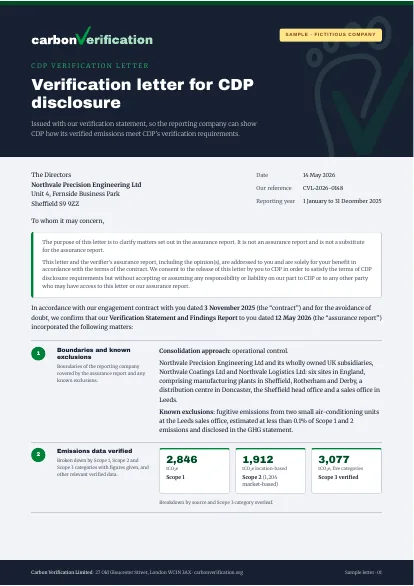
With your verification statement, we complete CDP’s verification letter. It confirms the boundary, emissions by scope and category, period, verification standard, assurance opinion, provider and lead verifier, so your team can attach it to your CDP response. This sample uses a fictitious company.
Download the sample letter (PDF, 2 pages)We document the verification method and agreed coverage clearly, so your team can use the statement as evidence in its CDP response. If CDP raises a question about our statement, we review it and respond with the relevant verification evidence.
Questions before you start
Discuss your intended CDP score, emissions coverage and deadline. We’ll plan ISO 14064-3 verification and the supporting statement, with a free readiness review to help your team prepare.
20-minute introductory call · No obligation